

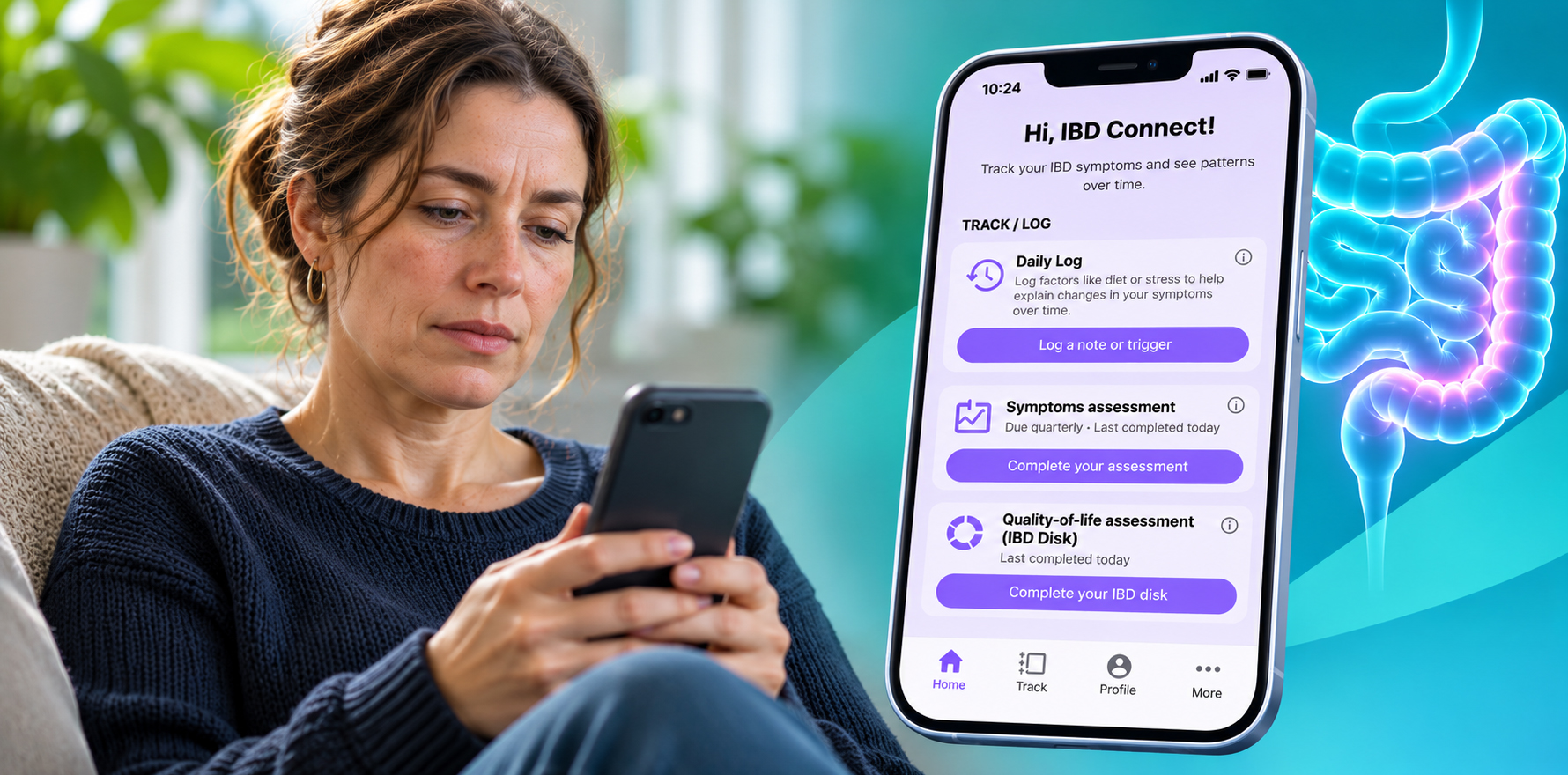
A free Australian-developed app aims to bring patients’ experiences between clinical appointments into treatment decisions.
Leading Australian peak body Crohn’s Colitis Cure has launched a mobile app designed to give gastroenterologists a more comprehensive picture of how patients with inflammatory bowel disease experience and manage their condition between clinical appointments.
The app, also developed by the not-for-profit CCCure, is known as IBD Connect and enables patients to track symptoms, record lifestyle events and potential triggers, monitor physical and emotional wellbeing, and access information about their condition.
The free app, co-designed with consumers in Australia and New Zealand, also lays the groundwork for integrating patient-reported information with clinical data to support more personalised care.
More than 180,000 Australians live with IBD, including Crohn’s disease and ulcerative colitis, with many experiencing pain, fatigue, anxiety, and unpredictable symptoms that may not be adequately captured during routine consultations.
CCCure chair and gastroenterologist Professor Jane Andrews said the app represented an important step towards a more connected, patient-driven approach to chronic disease management.
“Much of our understanding of IBD comes from what we hear during clinical appointments. But these are only snapshots of a disease that people live with every day,” she said.
“Between appointments, symptoms can change, treatments may not be working as expected, and people’s physical and emotional wellbeing is also affected in ways that are not always visible to their treating team.
“IBD Connect helps bridge that gap by giving people a way to record and better understand their experiences over time.”
The app forms part of CCCure’s broader learning health system, which includes Crohn’s Colitis Care (CCCare), a clinical management platform and clinical quality registry, and IBD Perfect, a real-time, binational benchmarking and quality improvement program.
The addition of patient-reported information to these existing initiatives could help clinicians identify unmet needs, better understand treatment responses, and inform therapeutic decision-making.
Related



“Bringing together clinical information, national benchmarking, and the experiences of people living with IBD creates an opportunity to build a healthcare system that is much more responsive to individual needs, and therefore more efficient,” Professor Andrews said.
“We want people to have faster access to the right therapy, including new medicines and a better chance of receiving that correct treatment from the outset, rather than spending years navigating different therapies before achieving disease control.”
The initiative also aims to improve continuity of care for patients navigating fragmented healthcare services, who may have difficulty accessing their medical information or find themselves repeatedly recounting their clinical history to different healthcare providers.
Future updates to the app are intended to give patients access to their own continually updated health information, regardless of where they receive treatment.
“People living with lifelong conditions should have access to the information they need to understand their disease, navigate their care and participate meaningfully in decisions about their health,” Professor Andrews said.
“It is about moving from a system in which people are largely passive recipients of care to one in which they are informed and active participants.”
Improving access to clinical trials is another longer-term ambition, with the potential to address recruitment challenges for researchers while increasing patient awareness of relevant investigational therapies.
“Too often, people are unaware of trials that may be relevant to them, while researchers face challenges identifying and recruiting eligible participants,” Professor Andrews said.
“By improving those connections, we have an opportunity to accelerate clinical research and potentially shorten the time it takes for new treatments to reach the people who need them.”
Patients can use IBD Connect independently of their hospital or treating service, including those whose gastroenterologists do not currently use CCCare.
Integration with CCCare will be progressively introduced through participating clinical services, creating further opportunities to incorporate patient-reported information into routine IBD management.
IBD Connect is available free of charge through the Apple App Store and Google Play, with further information available on the CCCure website.
