


Retrospective research suggests that CD patients who show signs of healing across multiple modalities have better long-term outcomes than patients who only show improvement in one.
Crohn’s disease patients who achieve both endoscopic and radiologic healing have better long-term outcomes than patients who only achieve one, new Canadian research has shown.
The retrospective cohort study, published in Inflammatory Bowel Diseases, followed 180 adult (≥18 years) patients with CD (73 males, mean disease duration 12.5 years) for a median of 76 to 78 months to determine whether transmural healing was associated with a lower risk of long-term CD-related surgery and hospitalisation.
“CD is characterised by transmural inflammation and often leads to structuring or penetrating complications requiring bowel resection,” wrote the researchers.
“Achieving endoscopic healing (EH) has been associated with improved long-term outcomes. [However,] patients with CD who demonstrate EH in the terminal ileum may still have active inflammation more proximally, which is beyond the reach of ileocolonoscopy.
“A recent systematic review reported that achievement of transmural healing (TH) is associated with a higher likelihood of clinical remission and lower rates of intestinal resection. However, this evidence is based on a limited number of observational studies.”
Of the 180 patients, 38 achieved EH (not having visible ulceration on an endoscopic assessment, including aphthous ulcers on ileocolonoscopy), 23 met criteria for radiologic healing (RH, no active inflammatiuon, extraenteric signs, or CD-related complications on cross-sectional imaging), 48 had TH (both EH and RH), and 71 displayed no evidence of healing (NH; inflammation on both ileocolonoscopy and cross-sectional imaging).
A greater proportion of patients who experienced TH had undergone perianal surgery compared to the other healing groups (16.7% versus 8.7% for RH, 0% for EH, and 11.3% for NH). A smaller proportion of patients with TH had a C-reactive protein level exceeding 5mg/mL (16.7% versus 39.1% for RH, 26.3% for EH, and 39.4% for NH).
Patients with TH had a lower cumulative probability of experiencing CD-related hospitalisation or surgery compared to the other healing groups after five years. Specifically, these patients had a lower cumulative probability of needing CD-related surgery compared to NH and EH patients. There were no differences in the cumulative probability of CD-related hospitalisations.
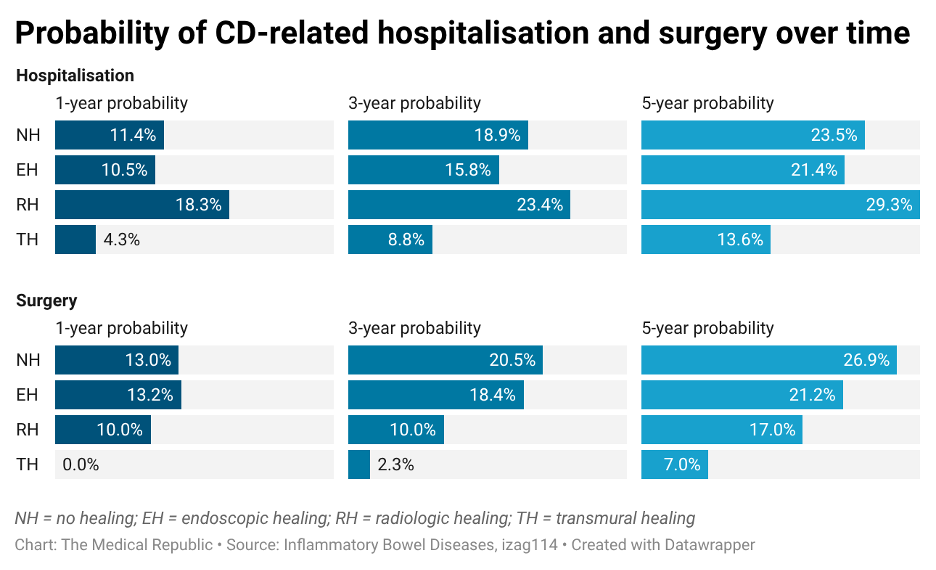
After accounting for the effects of clinical factors such as haemoglobin, albumin and CRP levels, biologic use, and smoking status, there was no association between the type of healing experienced by patients and the risk of CD-related hospitalisation. However, patients with TH were 11% less likely to require CD-related surgery compared to patients with NH (adjusted relative risk and 95% confidence interval 0.89, 0.80-1.00).
“Our findings align with previously published literature, supporting the notion that TH can be considered a potential future treatment target,” the researchers concluded, before elaborating on some of the obstacles that need to be overcome before TH can be adopted as a treatment target.
“There is no universally accepted definition of TH,” they said. “The most commonly used imaging parameter to define TH is bowel wall thickness (≤3mm). Some studies have used a more stringent definition of absence of any sign of inflammation including complications, and even incorporated absence of inflammation on ileocolonoscopy.”
In addition, the researchers noted that it remained challenging to achieve TH despite improvements in biologic therapies.
“Therefore, future studies should evaluate treatment strategies aimed at increasing the likelihood of achieving TH. Emerging evidence suggests that treating early in the disease course increases the chances of attaining TH,” they wrote.
